Christana: A Festive Display Font That Feels Like Holiday Magic
I was elbow-deep in candle label testing one crisp November afternoon—wax still warm on my fingers, printer humming softly—when I opened Christana for the first time. Not as a theoretical font choice, but as a real tool: a hand-drawn, holiday-inspired display font that instantly made my “Cinnamon & Pine” soy candle label feel like it belonged beside handmade ornaments and twine-wrapped packages. That’s the thing about Christana—it doesn’t just sit on the page. It leans in, sparkles quietly, and says, “This is special.”
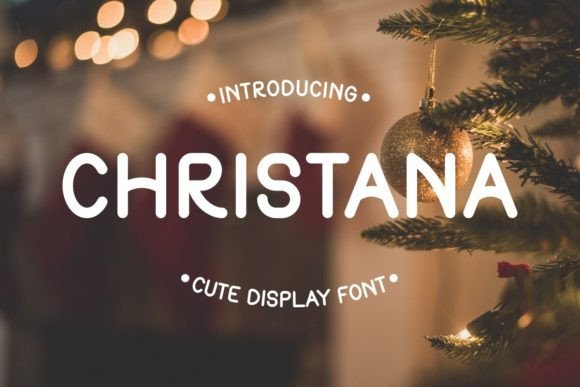
Christana is a premium display font crafted with warmth and intention. Its letterforms balance gentle curves with subtle structure—rounded terminals, soft serifs on select capitals, and a light, airy rhythm that breathes without crowding. There’s no harsh contrast or aggressive sharpness; instead, it carries a quiet elegance that feels both nostalgic and fresh. Think of it as the typographic equivalent of a woolen blanket, a mug of spiced cider, or the first snowfall caught in a windowpane—cozy, intentional, and full of quiet joy.
I reached for Christana first when designing a set of printable Christmas tags for gift boxes. Its natural flow made even short phrases like “For You With Love” or “Hand-Poured • Small Batch” feel personal and heartfelt—not generic, not rushed. Because Christana is built for display use, it shines brightest at larger sizes: 24pt and up on greeting cards, 36pt+ on wall art prints, and boldly scaled across tote bags or wooden signs. It’s not meant for body text or long paragraphs—and that’s by beautiful design. Its strength lies in moments of emphasis: a title on a planner cover, the name on a wedding welcome board, the flavor name on a boutique soap label.
When I tested Christana on actual product labels—especially small ones like 1.5" round sticker seals for tea tins—I paid close attention to legibility at reduced scale. The uppercase “A,” “R,” and “S” hold their shape cleanly, and the lowercase “e” and “a” remain distinct without tight counters. For Cricut and Silhouette users, I found it cuts crisply at 20pt and above on vinyl and matte sticker paper. On printed cards and packaging, it holds up beautifully in both digital and offset print—no pixelation, no muddy edges—thanks to its clean vector outlines and thoughtful spacing.
What makes Christana especially valuable for makers is how naturally it supports brand consistency across physical and digital formats. I used it across three touchpoints in one seasonal launch: the bold header on my digital printable Advent calendar pages, the festive script-style “Merry & Bright” banner on my Etsy shop banner, and the elegant title treatment on kraft paper gift tags tied to ceramic mugs. Even though each item served a different purpose, Christana unified them—not through repetition alone, but through shared tone and texture.
Pairing Christana thoughtfully deepens its impact. I often pair it with a clean, neutral sans serif—like Montserrat Light or Inter Regular—for supporting text on cards or packaging. That contrast lets Christana breathe while keeping information clear and accessible. For wedding stationery, I’ve layered it over a delicate handwritten font for names (think flowing “Emma & James”) and anchored it with a grounded serif for addresses and details. And for rustic farmhouse signs or chalkboard-style digital mockups? Christana beside a simple slab serif—like Playfair Display or Lora—adds just enough sophistication without losing warmth.
Before using Christana commercially—whether on physical products like shirts, mugs, or stickers, or in digital downloads like Canva templates or printable planners—I always double-check what’s included in the file package. Most versions come with OTF and TTF formats, basic OpenType features like standard ligatures and stylistic alternates (which add subtle charm to words like “Joy” or “Noel”), and multilingual support covering Western European languages. Crucially, it’s licensed for commercial use—so yes, you can embed it in SVG files for cutting machines, include it in editable PDF templates, or use it to design shop-branded packaging you sell directly to customers.
One of my favorite real-world uses? Hand-lettered-style planner pages for December. I placed Christana as the month header—centered, slightly spaced, at 72pt—then added minimalist line art of holly and berries beneath. It didn’t shout. It invited. Customers told me those pages felt “like flipping open a cherished holiday journal”—not because of the illustrations alone, but because Christana carried the mood before a single word was read.
It also works beautifully on tactile items. I printed Christana onto linen-textured cardstock for holiday greeting cards, and the font’s soft edges echoed the paper’s natural grain. On ceramic mugs, its rounded forms translated smoothly into glaze transfers—no awkward thinning or breakage in the curves. Even on woven cotton tote bags, where embroidery digitizing can flatten nuance, Christana’s sturdy proportions held up when converted to stitch files.
If you’re choosing fonts for seasonal products—especially those meant to evoke tradition, warmth, or quiet celebration—Christana offers something rare: authenticity without cliché. It doesn’t rely on snowflakes or bells built into letters. Instead, it earns its festive spirit through rhythm, proportion, and care. It’s the kind of display font that reminds you why typography matters—not as decoration, but as emotional shorthand.
So whether you’re prepping candle labels for your holiday market stall, sketching mockups for a client’s Christmas party invites, or building a cohesive set of digital printables for your Etsy shop, let Christana do more than fill space. Let it carry the feeling you want people to hold in their hands—and hearts.